Non-contact sheet resistance and layer thickness measurement solutions for process control
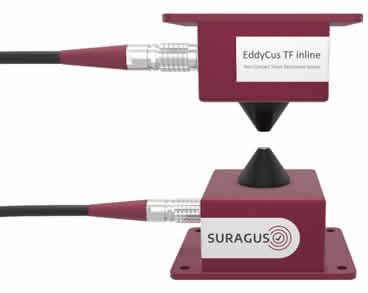
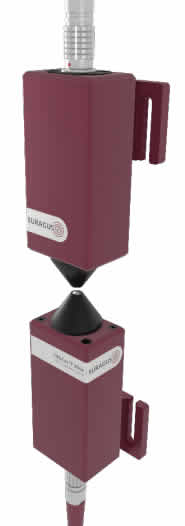
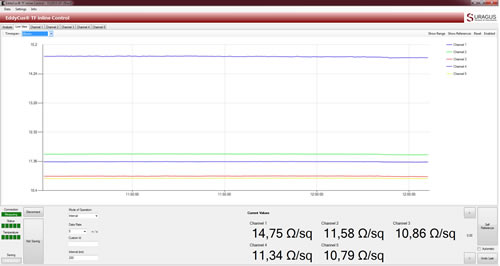
The EddyCus TF inline series measures layer properties such as metal layer thickness or sheet resistance in non-contact on various substrates. Typical substrates are glass, foil, paper, wafer, plastic or ceramic. Measurements are obtained by permanent measurements or by trigger events to obtain equidistant results in fast moving coating processes or measure on specific positions on small specimen. Monitoring is possible in atmosphere and in vacuum. The measurements are obtained using high samples rate and can be directly provided for process control systems and customer software. Additionally SURAGUS offers the monitoring software EddyCus TF control that visualizes, stores and analyses metrology data.
Advantages
• Non-contact real time measurement
• High measurement speed up to 1,000 measurements/ sec.
• Fixed sensor installation or traversing sensor installation
• Integration of 1 – 99 monitoring lanes per system
• Process control at atmosphere or in vacuum
• Measurements very close to the edge of the substrate are possible in many applications
• Long term stability by temperature compensated measurements in changing environment
• Large distances to the testing material (eg. gap of 60 mm / 2.4 inch)
• Characterization of covered conductive layers or encapsulated substrates
• Numerous software integrated analysis and statistic functions
• Easy set up by EddyCus RampUp software incl. wizard for system calibration
• Wear- free
Measurement applications
Sheet resistance measurement of 0.1 mOhm/sq up to 1 kOhm/sq
Determination of the layer thickness of metal layers from 2 nm – 2 mm
Layer thickness measurement of metal foils
Measurement of the residual moisture in wet layers by non-contact permittivity measurement
Processes
Deposition (PVD, ALD, (PE)CVD, electroplating, printing, spraying etc.)
Ablation/ structuring (etching, polishing, laser etc.)
Doping/ Implantation
Tempering/ AnnealingDrying/ Heating
Applications
• Architectural glass (LowE layers)
• Packaging materials
• Displays and touch screens
• Photovoltaics
• Mirror coatings
• Capacitors
• OLEDs and LEDs
• Smart glass
• Metal layers and wafer metallization
• De-icing and heating
• Batteries and fuel cells
• Coated paper and conductive textiles
• Graphene layers
• Antibacterial coatings
Motivation for the use of inline metrology
Process optimization/ control for fast and homogeny deposition
Efficient layer stack according to the functionality (e.g. high transparency and low resistivity, good emissivity, good barrier properties)
Increasing of the layer homogeneity especially on large substrates
Optimization of the processing time and machine utilization
Optimization of material input / usage (sputter target)
Planning of maintenance cycles (predictive maintenance“)
Quality assurance
SURAGUS offers inline and offline testing systems to support the achievement of those goals.